Free tournament bracket makers compared: limits and prices (2026)
9/30/2026
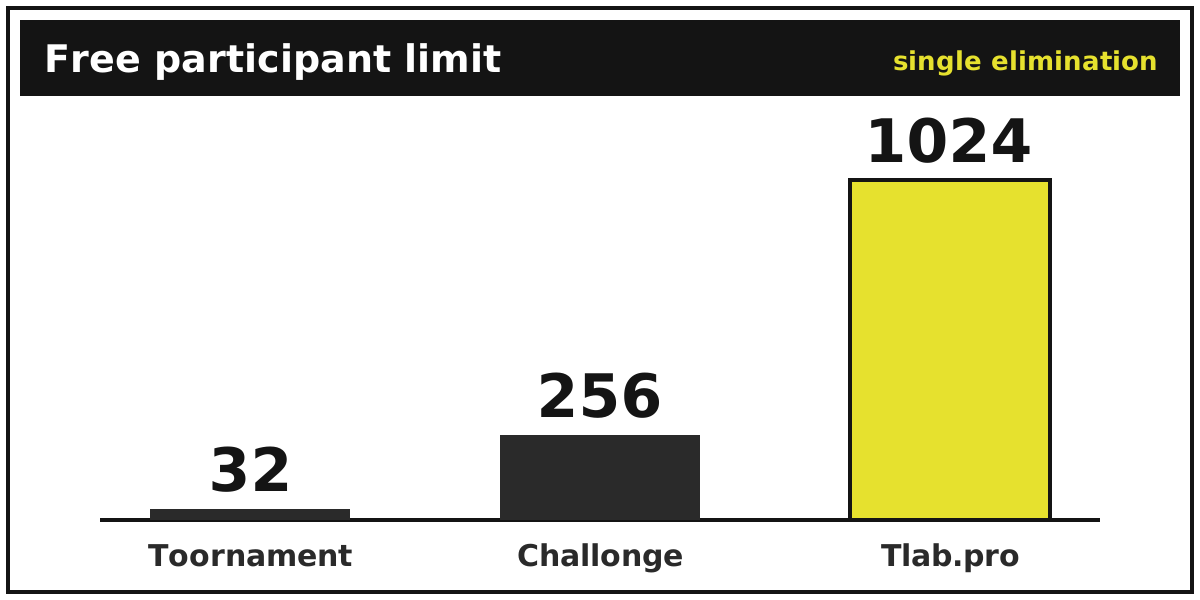
You have a tournament and a rough head count, and you want to know one thing before you pick a tool: will the free plan hold everyone, or will you hit a wall halfway through registration? Here is the short answer for the five services people compare most often — Challonge, Toornament, start.gg, Battlefy and Tlab.pro — with participant limits, prices and fees on entry payments, followed by what each one is actually good at. Tlab.pro is our own service, so its weak points get a section of their own.
The short answer: limits and prices side by side
| Service | Free: participants | Paid: participants | Paid price | Cut of entry fees |
|---|---|---|---|---|
| Tlab.pro | 1024 / 128 / 64 (single elim. / double elim. and Swiss / round-robin), with ads | the same | $2 / $9 / $39 a month, or about $3 for one tournament for a year | no entry fees |
| Challonge | 256, with ads | 512 (Premier) | $6.99 a month, billed yearly | $0.75 per order; none on Premier |
| Toornament | 32 | 128 with Boost | Boost €19 per tournament; plans from €19 a month | 0% on Community |
| start.gg | free; limit not published | — | — | 6% on top of the player's payment |
| Battlefy | basic tier; limit not published | not published | not published | not published |
Data as of September 2026, from the services' public pages. Challonge figures were checked by hand on its pricing page on 30 September 2026.
The prices in full. Challonge Premier costs more when paid monthly, and its free plan charges $0.75 per order on registrations paid through Stripe. Toornament's plans are Community at €19 a month billed yearly or €29 monthly, Circuit at €69 / €89 and Arena from €229 / €299. The Tlab.pro plans remove ads, raise the number of active tournaments and stop archiving — the participant limits stay the same; the code for a single tournament is described below. Battlefy offers paid registration but does not publish its fee.
In single elimination that makes the Tlab.pro free limit four times Challonge's free 256 and 32 times Toornament's free 32. That comparison only holds for single elimination: in double elimination and Swiss, the free Challonge is bigger — 256 against 128.
What Tlab.pro doesn't have
A comparison that only lists strengths is an advert. These are the gaps you should know about before choosing Tlab.pro:
- No automatic group stage → playoff. Challonge and Toornament move qualifiers from groups into a bracket by themselves. In Tlab.pro you run the groups as a round-robin and the playoff as a second tournament, link them together and add the qualifiers to the bracket yourself.
- No entry-fee collection. If players pay to enter, you take the money outside the service.
- No native mobile app. The site works in a phone browser, but there is nothing to install and no push notifications.
- Players need an account to enter their own scores. The organizer can run everything alone, but for players to report results each of them has to register.
- Built for sport and board games, not esports. There is no Discord integration and no game lobbies.
- The free plan has limits of its own: ads, up to 10 active tournaments at a time, and a tournament stays editable for three months before it moves to the archive. Challonge's free plan allows unlimited tournaments.
- Double elimination and Swiss stop at 128. For a 200-player double elimination bracket, the free Challonge fits and Tlab.pro does not.
How many players fit for free — and why it matters before you open registration
A participant limit rarely bites on day one. It bites when the sign-up form is already public: a school chess open expects 150, the link travels round three chats, and entry number 257 arrives two days before the event. On Challonge's free plan that is the moment you either pay for Premier (which covers 512) or split the field into two brackets with a final between their winners — which means announcing a different format to people who have already registered.
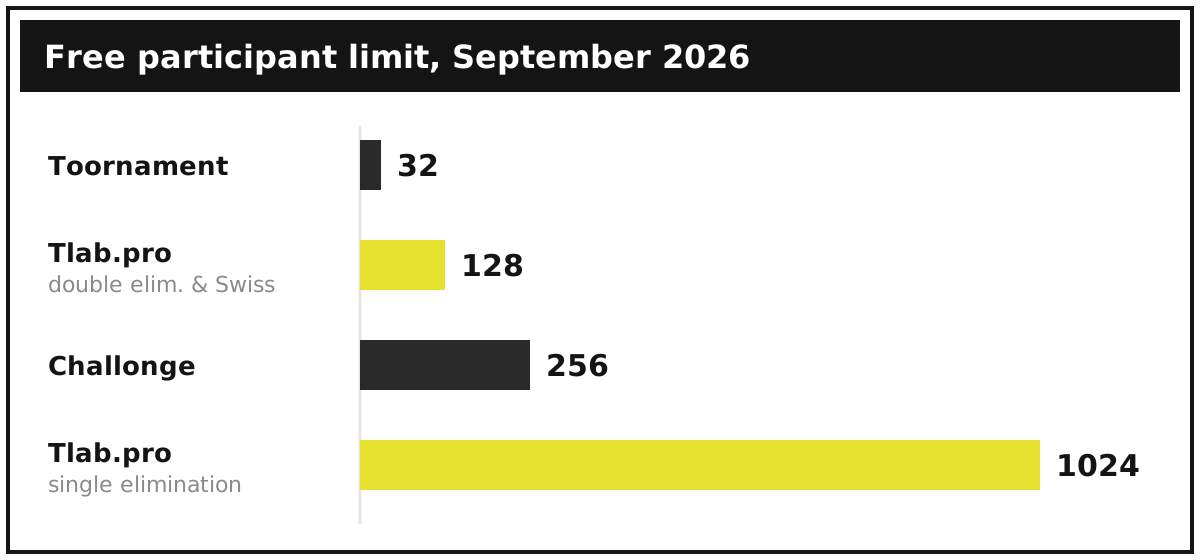
start.gg and Battlefy do not publish a free participant limit, so they are not on the chart.
Two habits save the trouble. First, compare the limit with the maximum you could get, not the number you expect — open registrations tend to overshoot. Second, remember that a knockout bracket rounds up to a power of two anyway: 300 entrants need a 512-slot bracket with 212 byes, and how byes are counted and placed is worth reading before the draw. The limit also depends on the format: the same service can give you 1024 places in single elimination and far fewer in a round-robin, because an all-play-all of 64 people is already 2016 matches.
Round-robin: how many times each pair can meet
In a round-robin the number that matters is not only the headcount but how many times everyone plays everyone. In Tlab.pro participants can meet once or up to five times, and the participant cap shrinks as the circles grow, so the schedule stays playable:
| Circles | Up to participants | Matches at the cap |
|---|---|---|
| 1 | 64 | 2016 |
| 2 | 48 | 2256 |
| 3 | 32 | 1488 |
| 4 | 24 | 1104 |
| 5 | 16 | 600 |
For comparison: Challonge offers a round-robin played once, twice or three times (Round Robin 2x and 3x). Toornament's round-robin groups are single or home-and-away; more meetings than that are set by hand in its pairing table, an advanced feature. In Tlab.pro a club ladder, a chess club's winter league or a weekly darts evening where a small group plays four or five circles is one option in the wizard, and the season can be split into matchweeks. How rounds and schedules are counted is in the round-robin guide; the tool itself is on the round-robin generator page.
Which service suits which tournament
Esports and fighting games — start.gg or Challonge. start.gg is the standard of the fighting-game community and runs events such as Evo and CEO: registration, entry fees, pools and venues in one place, and since 13 August 2026 native iOS and Android apps. The tool is free for the organizer; players pay a 6% platform fee on top of their entry. Challonge, owned by Logitech since 2019, is the most recognised bracket generator online, with a two-stage format (groups, then playoff) and embeddable brackets — a good fit for a gaming community of up to 256.
Game publishers and school esports leagues — Battlefy. It is built around partnerships with publishers and North American scholastic leagues. Prices are not published, so expect to talk to sales.
A serious multi-stage league with a budget — Toornament. Multi-stage structures, leaderboards across a circuit, branding and an API are its strengths, but they live on the paid plans. A one-off Boost at €19 covers a single event of up to 128.
School, club and amateur sport — Tlab.pro. This is the case it was built for: a knockout of several hundred players without a paid plan, standings with automatic statistics and calculated columns, leagues that combine separate tournaments into one table with head-to-head results, self-registration, and embedding on your own site. Schools and universities can get the paid features for free — see TLab Edu and the guide to running a school tournament.
For tennis, badminton and padel there are specialised systems tied to federation rankings and court bookings; if that is your world, they will serve you better than any of the five above.
Not sure which format your event needs in the first place? Start with how to choose a tournament format.
One tournament, no subscription: the one-year code
Not everyone organizes every month. For a single event Tlab.pro sells a one-time code for about $3 that gives one tournament the Organizer features for a year:
- no ads on the tournament's pages;
- its own address — tlab.pro/tournament/your-cup;
- custom CSS and a background image;
- the tournament is not archived for a year;
- it does not take up one of the ten active slots of the free plan.
The code is entered on the tournament's Premium tab; the participant limits are the same with or without it. The closest thing elsewhere is Toornament's Boost at €19 per tournament — but there the payment is what lifts an event from 32 to 128 participants, while in Tlab.pro the size is already free and the code pays for presentation — including the Premium widgets of the tournament page, such as a stream, a day schedule or sponsors (what the tournament page can show). Plans and codes are listed in the support section of the help; schools and universities get the same status free of charge through TLab Edu.
How to build a large bracket in Tlab.pro
- Create the tournament. Open the creation wizard, choose the playoff format with elimination after one loss. Single elimination takes up to 1024 participants; double elimination up to 128.
- Add the participants. If the count is not a power of two, one click on filling the remaining slots turns every empty place into a bye — no manual work for 300 names.
- Draw or seed. Shuffle the field, or star the seeded players so they land in protected positions; the draw and seeding guide explains the difference.
- Share the link. Above 128 players the bracket is shown in parts — each segment on its own plus a final block — and winners move to the next round as results come in. How single elimination works covers the rounds and the third-place match.
Frequently asked questions
Which bracket maker is free for 500 participants?
Among the services compared here, Tlab.pro in single elimination — it takes up to 1024 without payment. Challonge's free plan stops at 256 and its Premier plan at 512; Toornament's free plan stops at 32.
How much does start.gg charge players?
A 6% platform fee added on top of each online entry payment. The organizer does not pay for the tool itself.
Can I run groups and a playoff for free?
In Tlab.pro, yes, but by hand: a round-robin for the groups, a separate bracket for the playoff, linked together, with qualifiers added manually. Challonge and Toornament have a built-in two-stage format; on Toornament, multi-stage structures belong to the paid plans.
Is there a free double elimination bracket for 200 or more players?
Challonge's free plan allows up to 256 participants. Tlab.pro caps double elimination at 128, so it will not fit that field.
Can a round-robin be played more than twice?
In Tlab.pro, up to five circles — 16 participants at five, 64 at one. Challonge goes up to three (Round Robin 3x). In Toornament a round-robin group is single or home-and-away; more meetings are set by hand in the pairing table.
Can I pay for just one tournament?
Yes. A one-time code for about $3 gives one tournament no ads, its own address and custom styling for a year; the participant limits do not depend on it. Toornament's per-event Boost costs €19.
If your field is bigger than a free plan elsewhere allows, create the tournament — an overview of the tool is on the single elimination bracket generator page.