Single elimination: what it is and how the bracket works
5/17/2026
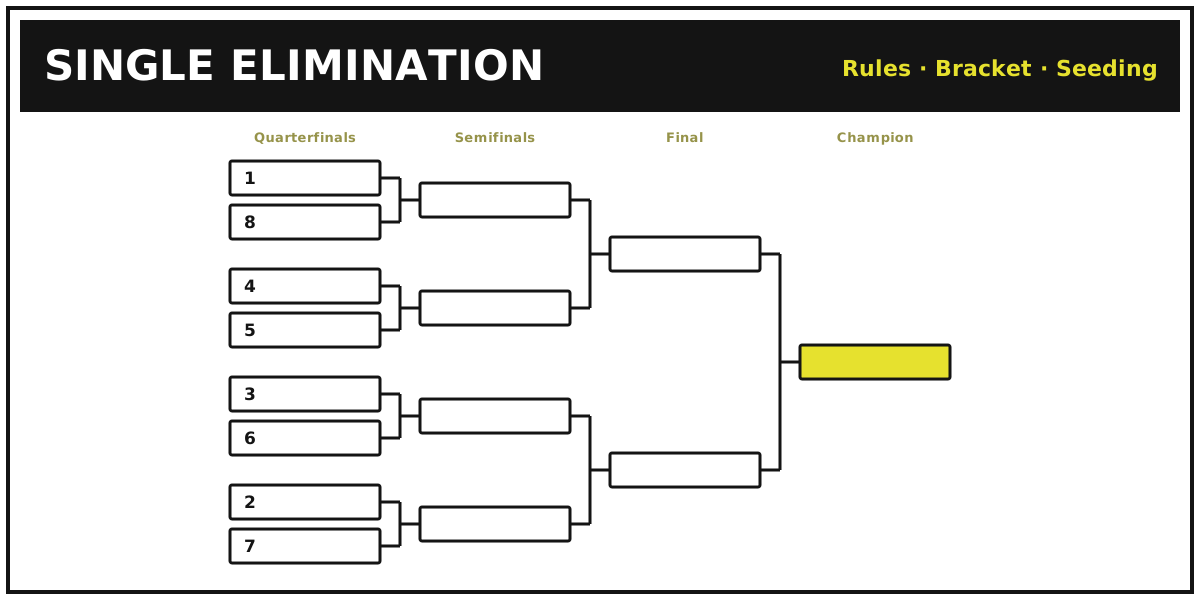
Single elimination — also called a knockout bracket — is the fastest way to turn a field of players into a single winner. One loss and you are out, so every match matters. It looks simple on paper, but a good bracket hides a few decisions: how many rounds you need, where the byes go, and who meets whom in the first round. Let's walk through all of it, and see how Tlab.pro builds the bracket for any number of participants.
The rules in one minute
- A participant who loses a match is eliminated. There is no second chance (that is what double elimination adds).
- Winners advance to the next round and are paired against other winners.
- The bracket is a binary tree: each round halves the field until one player is left.
- The number of rounds is log₂(N) — 8 players need 3 rounds, 16 need 4, 32 need 5.
- The last match is the final; its winner is the champion. You can optionally add a third-place match between the two losing semi-finalists.
Why the field is a power of two
A clean bracket needs the field to halve evenly every round, so the number of slots must be a power of two: 2, 4, 8, 16, 32, and so on. When the number of actual players isn't a power of two, you round up to the next one and fill the empty slots with byes.
A bye is a "free win" — a placeholder opponent. A player drawn against a bye advances to the second round without playing. The number of byes is simply:
byes = next power of two − number of players.
So 6 players fit into an 8-slot bracket with 2 byes; 12 players fit into 16 slots with 4 byes; 20 players need a 32-slot bracket with 12 byes. Worked examples for 5, 6, 10 and 12 entrants — including who should get the byes — are in tournament bracket for any number of players.
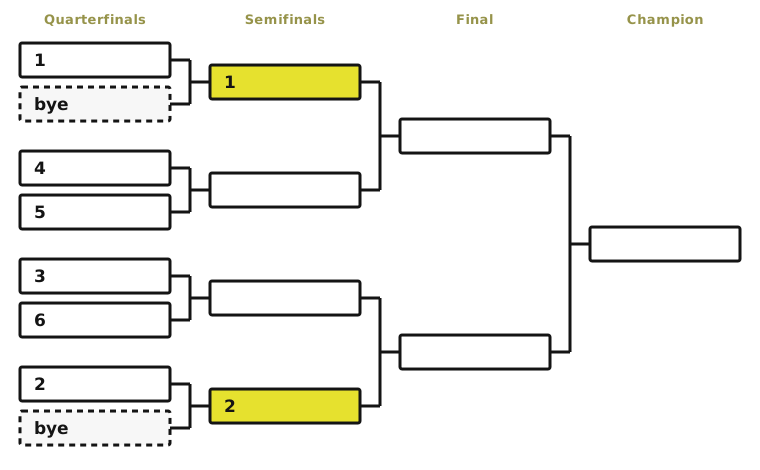
In Tlab.pro the bracket size is always a power of two (currently up to 1024 participants), and the byes are explicit: you add empty participants to fill the missing slots, so you stay in full control of where the "free wins" land.
Seeding: keeping the favourites apart
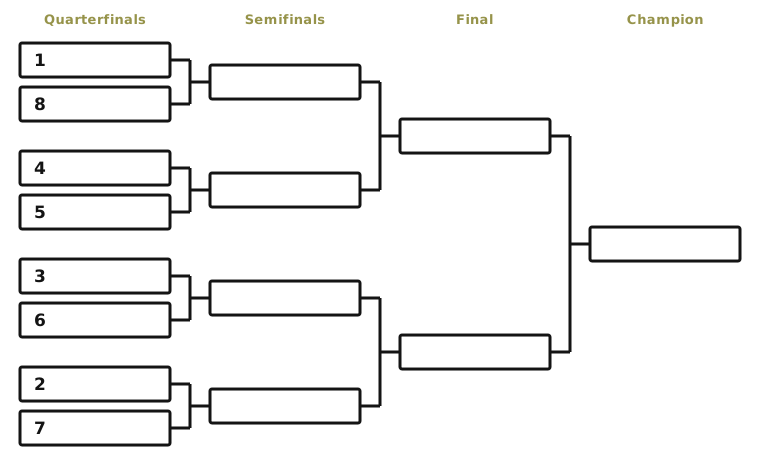
If you drop players into the bracket at random, the two strongest might meet in round one and one of them goes home immediately. Seeding prevents that. Players are ranked (by rating, past results, or a group stage), and the seeds are placed so that the top ones can only meet in the later rounds — 1 and 2 on opposite ends, 3 and 4 as far apart as possible, and so on.
The standard seeding order for 8 slots is 1 · 8 · 4 · 5 · 3 · 6 · 2 · 7 from top to bottom — exactly the arrangement in the bracket above. It guarantees that seed 1 and seed 2 can only meet in the final, and that byes, when present, go to the highest seeds first.
If you don't want seeding, that's a valid choice too: a random draw makes every path equally uncertain and is popular for casual or friendly events.
Building a bracket for N players
Put together, generating a bracket for any field is a short recipe:
- Round N up to the nearest power of two — that's your bracket size.
- Add
bracket size − Nbyes. - Order the players by seed (or shuffle them for a random draw).
- Place the seeds in standard order and hand the byes to the top seeds.
- Draw the rounds, halving the field each time until the final.
Here is how the numbers work out for a few common field sizes:
| Players (N) | Bracket size | Rounds | Byes |
|---|---|---|---|
| 5 | 8 | 3 | 3 |
| 6 | 8 | 3 | 2 |
| 8 | 8 | 3 | 0 |
| 12 | 16 | 4 | 4 |
| 16 | 16 | 4 | 0 |
| 24 | 32 | 5 | 8 |
| 32 | 32 | 5 | 0 |
Doing it in Tlab.pro
You don't have to draw any of this by hand. In the tournament creation wizard choose the Playoff format, set after how many losses a player is eliminated (one, for single elimination) and whether to hold a third-place match. Then add your participants: the bracket is generated from their order, or shuffled at random if you prefer. The full walkthrough — format options, seeding order, and the empty-participant byes — is in the help section.
When you are ready, create your tournament and let Tlab.pro build the bracket for you. A quick overview of the tool itself is on the single elimination bracket generator page.