What a tournament draw is and how it differs from seeding
7/15/2026
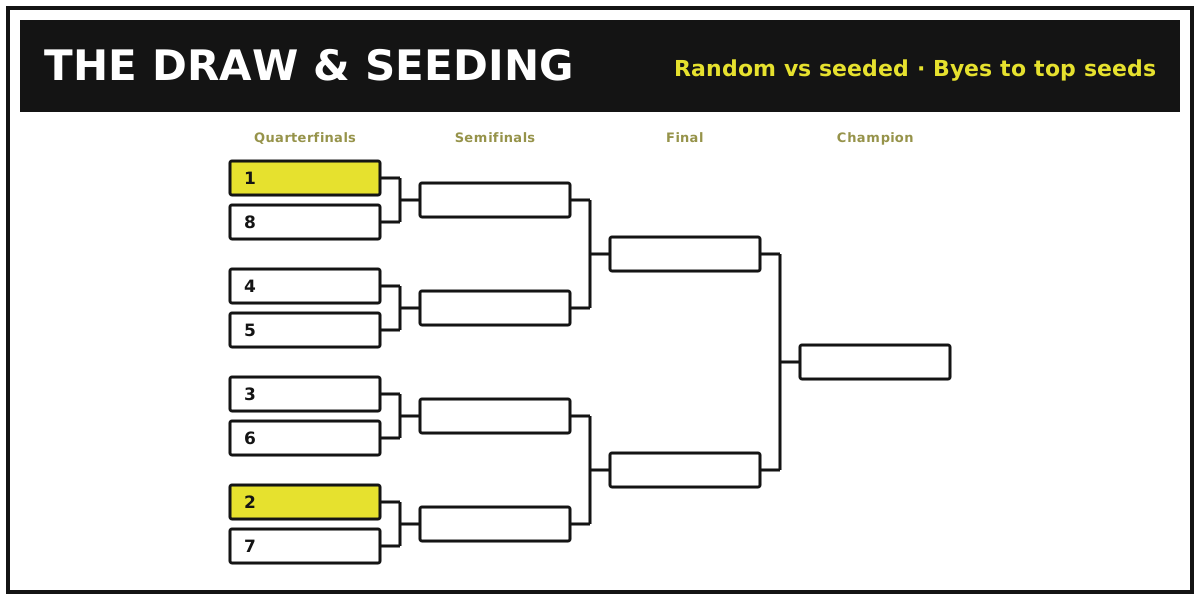
Once you have settled on a knockout format, one question decides how fair — and how interesting — the whole event will be: who starts against whom. That is what the draw settles. This guide explains what a draw is, why it matters, how a random draw differs from a seeded one, and what seeding actually does to a bracket.
What a draw is
A draw is the step that assigns each participant to a slot in the bracket. Before the draw you have a list of names; after it, every first-round pairing is fixed and the path each player would take to the final is set. In a knockout, where one loss ends the tournament, that single placement can matter as much as the games themselves.
The draw can be done two ways: at random, or with seeding. Both are legitimate — they answer different questions.
Why hold a draw at all
- Fairness. Nobody should be able to hand-pick an easy or a hard path for a particular player. A draw — random or rule-based — removes that suspicion.
- Transparency. When the rule is stated in advance ("random", or "seeded by rating"), everyone can see the bracket was built by the rule, not by preference.
- Balance. A good draw spreads strength across the bracket so the tournament peaks at the end, not in round one.
Random draw vs seeded draw
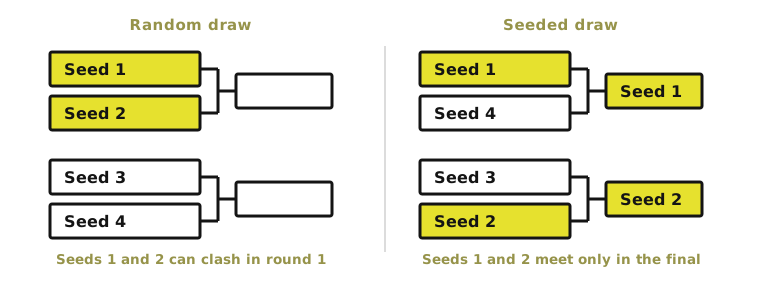
In a random draw every participant is dropped into the bracket by chance. It is simple, obviously impartial and popular for friendly or amateur events where nobody has a rating yet. The risk: the two strongest players can be paired in round one, and one of them goes home immediately — as in the left bracket above.
In a seeded draw the strongest players are placed so they cannot meet early. The draw is still partly random — players of similar strength are shuffled within their group — but the top names are anchored to opposite parts of the bracket.
What seeding is
Seeding means ranking the participants before the draw and using that ranking to place them. The rank can come from a rating, last season's results, a qualifying group stage or the organiser's own list. The seeds are then distributed by a fixed rule, so that the higher a player is ranked, the later they can first meet another top seed.
The core principle is simple:
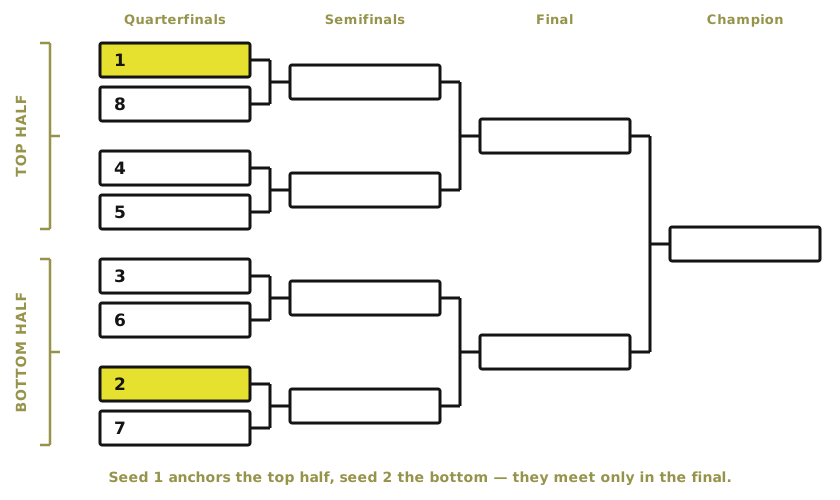
- Seed 1 and seed 2 go to opposite ends of the bracket — they can only meet in the final.
- Seed 3 and seed 4 head the two remaining quarters, as far from the top seeds and from each other as possible.
- Lower seeds fill the rest, each paired against a stronger seed in round one.
The standard order for an 8-slot bracket is 1 · 8 · 4 · 5 · 3 · 6 · 2 · 7 from top to bottom. It looks arbitrary, but it is exactly what keeps favourites apart: the top half is anchored by seed 1, the bottom half by seed 2, and seeds 3 and 4 lead the far quarters.
Seeding and byes
When the field is not a power of two, the empty slots are filled with byes — free first-round wins. Byes are handed to the top seeds first, so the strongest players skip round one. That is a natural reward for a high seed and keeps the bracket balanced. The mechanics of byes and bracket size are covered in single elimination — rules, bracket, and seeding, and how many byes a field of 5, 6, 10 or 12 needs is worked out in tournament bracket for any number of players.
When to skip seeding
Seeding assumes you can rank the field. If you can't — or you deliberately want an unpredictable, everyone-has-a-chance feel — a pure random draw is the better choice. Many amateur and social tournaments run this way on purpose.
Doing it in Tlab.pro
Tlab.pro supports both. When you create a tournament in the Playoff format, you can:
- Shuffle after creation for a random draw — participants are placed into the bracket at random.
- Turn on seeding, mark the seeded participants and set their seed numbers; Tlab.pro places them in the standard order and hands byes to the top seeds, while unseeded players are drawn at random around them.
The full walkthrough — the seeding field, the star markers and the shuffle option — is in the help section. To read how the bracket itself is built from the draw, see single elimination — rules, bracket, and seeding.
When you are ready, create your tournament and run the draw.