Tournament bracket for any number of players: byes explained
8/24/2026
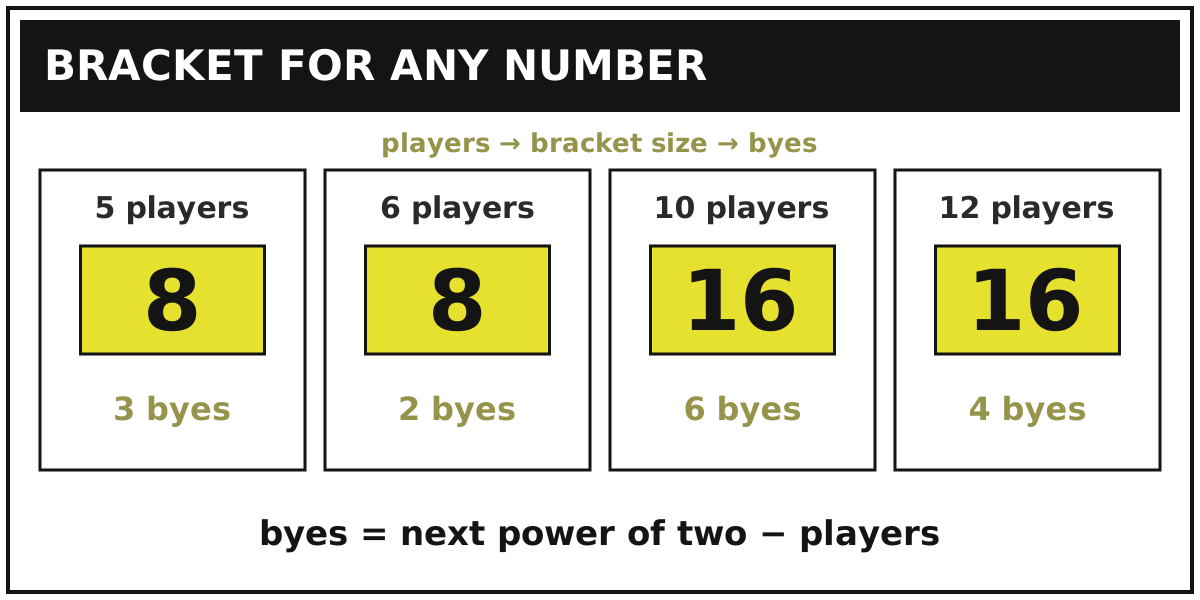
Five players. Or six, or ten, or twelve — and every bracket template you can find is drawn for 8, 16 or 32. There is nothing wrong with your field: a knockout bracket always holds a power of two, and the slots you don't fill become byes. This guide works out how many byes 5, 6, 10 and 12 participants need, who should get them, and how to end up with a bracket you can print or run online.
Why brackets come in 8, 16 and 32
A knockout bracket is a binary tree. Every round halves the field: 16 → 8 → 4 → 2 → 1. For that to run all the way down to a single winner, the number of slots must halve evenly each time — which only happens when it is a power of two: 2, 4, 8, 16, 32, 64, 128, 256, 512, 1024.
Five, six, ten and twelve are not powers of two, so they never fit a bracket exactly. The fix is not to cut anyone from the entry list: you round the bracket up to the next power of two and leave the surplus slots empty.
- 3–4 participants — a 4-slot bracket, 2 rounds;
- 5–8 — 8 slots, 3 rounds;
- 9–16 — 16 slots, 4 rounds;
- 17–32 — 32 slots, 5 rounds.
Notice what does not change: the number of matches. Every match eliminates exactly one participant, and everyone except the champion is eliminated, so a knockout is always N − 1 matches — 11 matches for 12 players, whatever size of bracket you draw around them. The empty slots cost you nothing in playing time.
What a bye is
A bye is an empty slot in the bracket — a placeholder standing where an opponent would be. The participant drawn against it has nobody to play in round one and goes straight through to round two. On paper it is usually drawn as a blank line, a dash, or the word "bye".
A bye is not a walkover: a walkover is a real opponent who entered and then failed to turn up, while a bye is a line that was empty from the moment the bracket was drawn. Two rules keep byes honest:
- Byes only exist in round one. After the first round every slot is filled by a winner. If you need an empty slot in the semi-final, the bracket was built wrong.
- One bye per participant. A bye is already an advantage; two would mean reaching the semi-final without playing.
How many byes: next power of two minus N
The whole calculation is one line:
byes = next power of two − number of participants.
So 5 players in an 8-slot bracket need 3 byes, 12 players in a 16-slot bracket need 4, and 20 players in a 32-slot bracket need 12. Here are the field sizes people ask about most often:
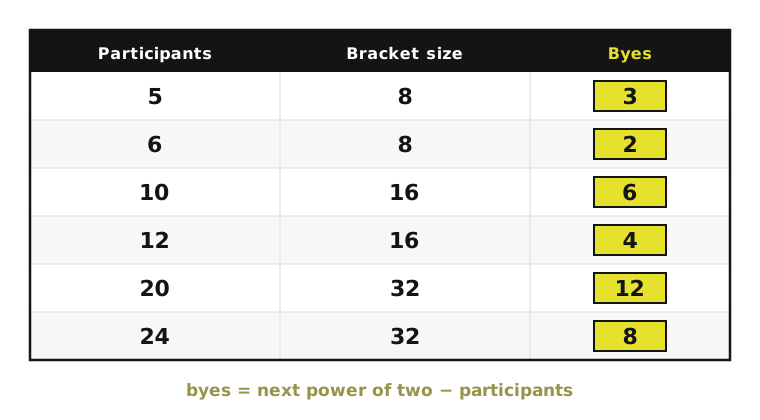
There is a second useful number: how many matches are actually played in round one. Half the bracket is first-round pairings, and each bye takes one of them off the schedule, so round-one matches = participants − bracket size / 2. For 12 players that is 12 − 8 = 4 matches; for 5 players it is a single match. Try your own field size:
Bye calculator
Bracket size: 16 · Byes: 4 · Rounds: 4 · Round-one matches: 4 · Matches in total: 11
Watch that ratio as the numbers grow: 20 players in 32 slots means 12 byes, so only 8 people play on the opening day. That is where a knockout stops being the obvious answer, and how to choose a tournament format walks through the alternatives.
Who gets the byes, and how seeding comes into it
A bye is a real advantage: a round of rest and no risk of an early upset. The standard rule, used from junior events to Grand Slams, is simple — byes go to the top seeds, starting with seed 1. Three byes means seeds 1, 2 and 3 skip round one; four byes means seeds 1 to 4 do. Everyone else plays, strongest against weakest among the seeds that are left.
No ranking and no seeds? That is fine too — but fix the rule before the draw and say it out loud: "the three byes are drawn at random". What causes arguments is not randomness, it is a rule invented after the names are on the board. How a random draw differs from a seeded one is covered in what a tournament draw is and how it differs from seeding.
One thing to check when you place byes by hand: never let two byes meet. A pair of empty slots sends an empty slot into round two, and someone in the quarter-final ends up with no opponent. The standard 8-slot seeding order 1 · 8 · 4 · 5 · 3 · 6 · 2 · 7 avoids this by itself, because the missing bottom seeds land opposite the top ones. That order is explained in the guide to single elimination and how the bracket works.
Worked examples: 5, 6, 10 and 12
5 participants
An 8-slot bracket, 3 byes, 3 rounds, 4 matches in total. Seeds 1, 2 and 3 go straight to the semi-finals; the only game on day one is 4 v 5. Top to bottom the bracket reads 1 · bye · 4 · 5 · 3 · bye · 2 · bye. This is the most lopsided of the common cases: for five players a round-robin gives everyone four games each.
6 participants
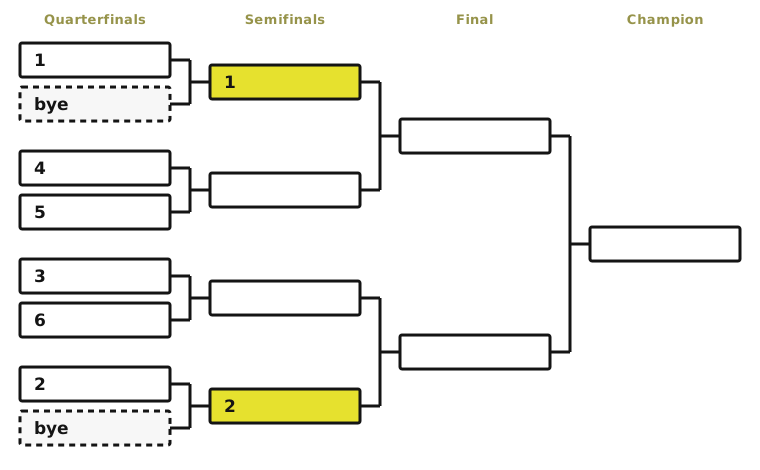
An 8-slot bracket, 2 byes, 3 rounds, 5 matches. Seeds 1 and 2 rest; round one is 3 v 6 and 4 v 5 — exactly the bracket in the picture above. Six is the friendliest non-power-of-two field there is: only two participants get a free pass.
10 participants
A 16-slot bracket, 6 byes, 4 rounds, 9 matches. Seeds 1 to 6 skip round one, leaving two opening matches: 7 v 10 and 8 v 9. More than half the field doesn't play on the first day, so for a one-day event two groups of five feeding a bracket of the top four is often the better shape.
12 participants
A 16-slot bracket, 4 byes, 4 rounds, 11 matches. Seeds 1 to 4 rest and round one is four matches: 5 v 12, 6 v 11, 7 v 10, 8 v 9. After that the bracket is full and behaves exactly like a normal 16-team draw — which is why twelve, the number people search for most, is also one of the tidiest.
A blank bracket: print it or fill it in online
Much of the search traffic here is really one request: give me an empty bracket for 12 teams that I can print. The thing to know first is that a blank bracket for 12 teams is a 16-slot bracket with four lines crossed out. There is no 12-line knockout grid, so the first decision is always the size, not the names.
If you are going to print it, do it in this order:
- Round the field up: 12 teams → a 16-slot sheet.
- Mark the bye lines before you write any names — otherwise you will be rubbing names out later.
- Write the seeds in first (1 at the top, 2 at the bottom), then everyone else.
- Leave room next to each line for the score, not just the winner's name.
Paper has one flaw that has nothing to do with drawing skill: it goes out of date. One team drops out an hour before the start and the sheet has to be redrawn; anyone not standing next to the wall has no idea what the score is. Filling the bracket in online fixes both — it is generated at the right size for the field you actually have, results push through to the next round on their own, and the same page works as a link for a chat group, a screen in the hall, or an image export if you still want paper. Names stay editable, so a blank bracket prepared in the morning becomes the real one by the afternoon.
How Tlab.pro does it
You don't have to round anything up by hand. In the tournament creation wizard choose the Playoff format, set elimination after one loss, and decide whether you want a third-place match. Then add participants — up to 1024 — and watch the list:
- As soon as your entries pass a power of two, the participant list grows to the next one by itself. Type five names and it becomes eight rows, three of them empty slots waiting to be dealt with.
- An empty slot becomes a bye when you tick Add a cell with a blank participant and press Add. The label is up to three characters, "-" by default, and the cell is greyed out so nobody mistakes it for a competitor. The tournament won't be created while a slot is still undecided — deliberately, so you have to look at where the free wins land.
- The arrows next to each row move participants up and down, so you choose who faces a blank cell.
- Long lists have two shortcuts, added in update 5.11.1: fill remaining slots turns every empty slot into a bye in one click, and the number in the # column is a field — type a new position and the participant moves straight there.
- Or let the draw do it: tick shuffle, then seeding, star the seeded participants and put them in order. Seeds take their protected positions and everyone else is drawn at random around them, while the blank cells always rank last — so the byes go to the top seeds automatically, even if only part of the field is seeded. A plain shuffle without seeding spreads the byes across the first round, so two of them never share a match unless byes outnumber players.
The step-by-step walkthrough of the wizard, the star markers and the shuffle option is in the help section.
Frequently asked questions
How many byes does a 12-team tournament need?
Four. Twelve teams go into a 16-slot bracket, and 16 − 12 = 4. The byes go to seeds 1 to 4, and round one is four matches: 5 v 12, 6 v 11, 7 v 10 and 8 v 9.
Can two byes be drawn against each other?
They shouldn't be. A bye against a bye sends an empty slot into round two, and some player in the quarter-final has no opponent. Place byes opposite real participants — the standard seeding order does this automatically, and if you are arranging the bracket by hand, check the pairs before the first match.
Who gets the bye if nobody is seeded?
Draw them at random, and announce that rule before the draw rather than after it. A bye is worth a match, so the only thing that makes it acceptable is that everybody knew in advance how it would be handed out.
Is a knockout still worth it for 20 participants?
It works, but look at the shape first: 20 in a 32-slot bracket is 12 byes, so only 8 people play in the opening round. For a single-day event, groups feeding a bracket, or a Swiss, will give everyone more games in the same amount of time.
Does a bye count as a win in the statistics?
Treat it as a round skipped, not a match won — there was no opponent and no score. It matters when you compare records afterwards: a player who came through a bye has played one game fewer than someone who started in round one.
Once you know your bracket size, create the tournament and let the byes fall where they should. A quick overview of the tool itself is on the single elimination bracket generator page.