Round-robin: how many matches, rounds, and how to schedule
6/10/2026
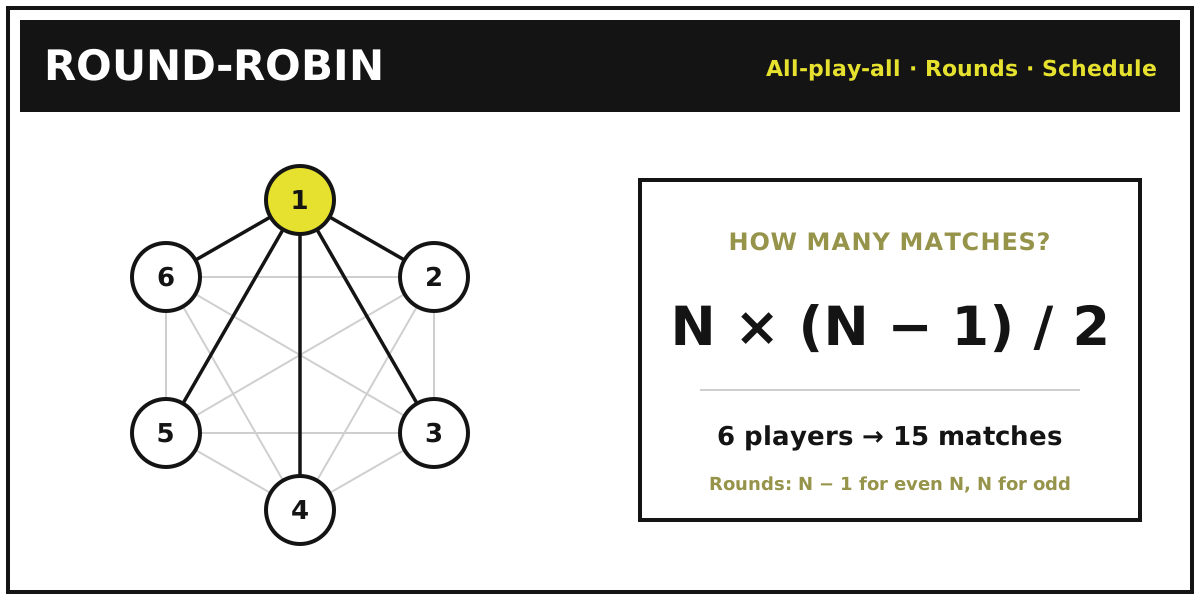
Round-robin is the fairest format there is: everyone plays everyone, and the final table reflects real strength rather than a lucky draw. The price is the number of matches, which grows quadratically. Let's work out how to count the matches and rounds for any field size, and how to build a schedule with no repeats — by hand with the circle method, or automatically in Tlab.pro.
The rules in one minute
- Every participant plays every other participant — once (a single round-robin) or several times.
- Nobody is eliminated: everyone plays to the end of the tournament.
- Results earn points (for example 3 for a win, 1 for a draw), and the total decides the final standings.
- Ties are broken by tie-breakers: head-to-head results, goal difference and other indicators.
How many matches: N × (N − 1) / 2
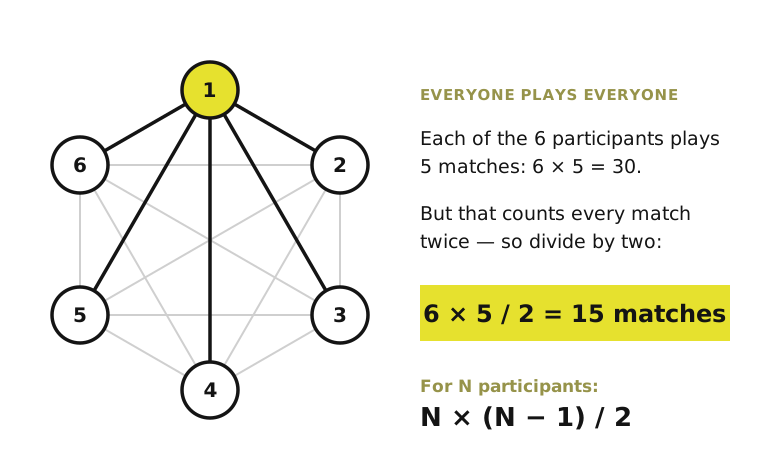
Each of the N participants has to play N − 1 matches — everyone except themselves. Multiplying gives N × (N − 1) meetings, but that counts every match twice — once for each of the two opponents. So we divide by two:
matches = N × (N − 1) / 2.
For 6 participants that is 15 games, for 8 it is 28, for 10 already 45. If every pair meets twice (a double round-robin), multiply the result by two.
Try it with your own numbers:
Round-robin calculator
Total matches: 28 · Rounds: 7 · Matches per round: 4
Notice how quickly the tournament grows:
| Participants (N) | Matches (single) | Matches (double) | Rounds | Matches per round |
|---|---|---|---|---|
| 4 | 6 | 12 | 3 | 2 |
| 6 | 15 | 30 | 5 | 3 |
| 7 | 21 | 42 | 7 | 3 |
| 8 | 28 | 56 | 7 | 4 |
| 10 | 45 | 90 | 9 | 5 |
| 12 | 66 | 132 | 11 | 6 |
| 16 | 120 | 240 | 15 | 8 |
This is exactly why a round-robin is usually recommended for up to about 10–12 participants: beyond that the schedule grows faster than the fun. For a bigger field, have a look at the other formats.
How many rounds
Matches are conveniently grouped into rounds: within one round a participant plays at most one match. The minimum number of rounds depends on whether N is even or odd:
- Even N: N − 1 rounds with exactly N/2 matches in each — everybody plays.
- Odd N: N rounds with (N − 1)/2 matches in each — one participant rests each round (gets a bye).
So 8 participants fit into 7 rounds of 4 matches, and 7 participants also need 7 rounds, but of 3 matches, with everyone sitting out exactly once.
The circle method: a schedule with no repeats
How do you arrange the pairs so that over N − 1 rounds everyone plays everyone exactly once and nobody plays twice in the same round? The classic answer is the circle method. Write the participants in two rows facing each other: the pairs of the round are the ones standing opposite. Then fix one participant in place and shift everyone else by one position around the circle — that gives the next round. Repeat until the circle closes. For an odd N add a dummy participant: whoever faces the dummy rests that round.
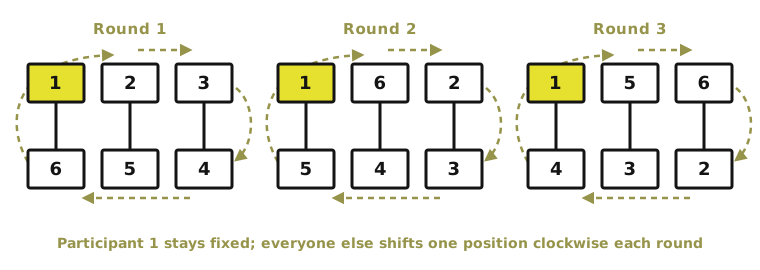
A schedule built this way guarantees that no pair ever meets twice and everyone plays exactly one match per round.
Doing it in Tlab.pro
You don't have to count and arrange anything by hand. In the tournament creation wizard pick the Round-robin format and set how many times the participants play each other — from once up to five times. The full wizard walkthrough is in the help section.
The schedule builds itself: enable the Matchweeks option in the tournament settings and click Create new matchweek — Tlab.pro suggests the pairs using the circle method, shows who rests that round, and lets you swap participants or regenerate the whole matchweek. The details are in the help topic about matchweeks in a round-robin.
From there you just enter the results — the table recalculates itself, and automated statistics counts points, goal difference and any other indicator without manual input. You can even let the participants enter results themselves.
If the round-robin is a group stage before a playoff, link the stages together: the tournaments share one menu, and the playoff page gains a block with the group tables. Moving the qualifiers into the bracket is still your call — nobody is promoted automatically. A worked example of that combination — two groups of four, semi-finals and a final — is in the guide on how to run a football tournament. And for the knockout brackets themselves we have separate deep dives: single elimination and double elimination.
When you are ready, create your tournament — Tlab.pro takes care of the formula, the rounds and the schedule. A quick overview of the tool itself is on the round robin schedule generator page.