How to run a football tournament: groups, playoffs, standings
9/4/2026
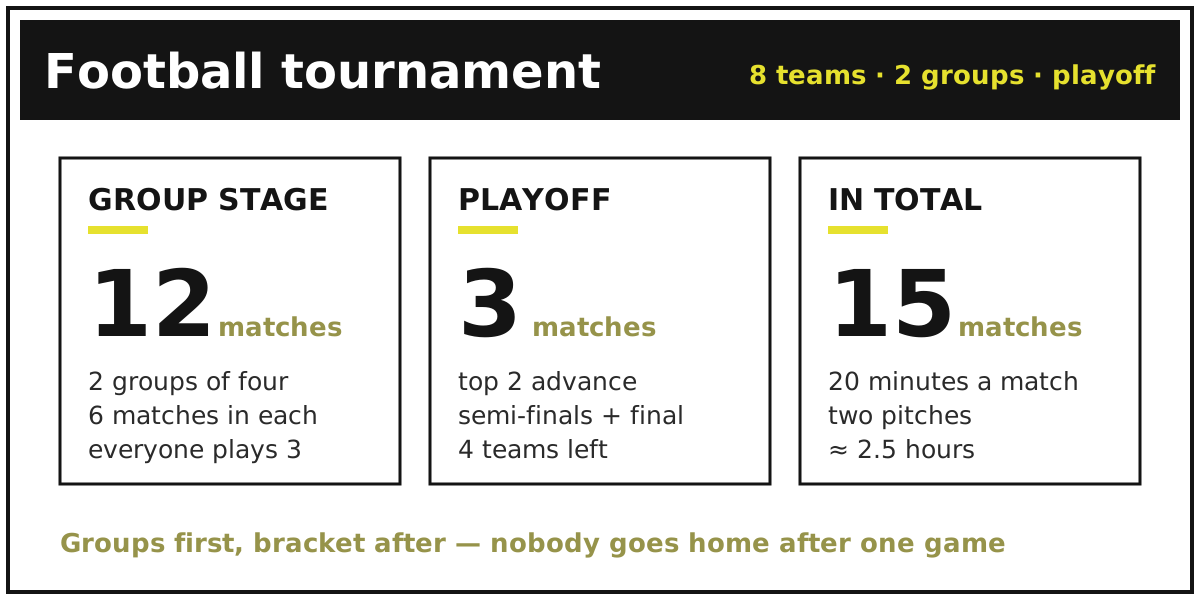
Eight teams have confirmed, you have two pitches and one Saturday afternoon. Those three numbers decide the rest: the format, how many games each team gets, and whether the trophy is settled by a final or by goal difference. A five-a-side works cup, a Sunday league play-off day and a school tournament run on the same arithmetic — here it is, to do before you announce anything.
How many teams and how much time you have
Three numbers size the tournament: N teams, T minutes of pitch time and P pitches.
A match takes more than the ball rolling: a slot is two halves, the break, and a couple of minutes to clear the pitch. Five-a-side with halves of eight minutes plus four for the changeover is a 20-minute slot; on a full pitch with 2 × 25 it is closer to an hour.
matches you can fit = T × P / slot
Four hours on two pitches at a 20-minute slot is 240 × 2 / 20 = 24 matches. That is the ceiling, and the format has to fit under it.
| Teams | Straight knockout | One round-robin | Groups + playoff | Group games per team |
|---|---|---|---|---|
| 8 | 7 | 28 | 15 (2 groups of 4) | 3 |
| 12 | 11 | 66 | 19 (4 groups of 3) | 2 |
| 16 | 15 | 120 | 31 (4 groups of 4) | 3 |
The spread is brutal: sixteen teams playing everyone is 120 matches, a season rather than a Saturday. The same sixteen in groups plus a knockout is 31.
Format: groups, round-robin or straight to a knockout
Straight knockout. N − 1 matches and nothing more: eight teams, seven games, a couple of hours. The cost is that half the field plays once and leaves. Use it when the clock is tight, or as the second half of a bigger event — the bracket itself is explained in the article on single elimination.
One round-robin. Everyone plays everyone: N × (N − 1) / 2 matches. The fairest option there is, and the table is not an accident of the draw. Realistic up to about six teams — 15 matches, a long but doable day. A Sunday league is the same format stretched over a season. The maths and the pairing method are in the guide to round-robin scheduling.
Groups plus playoff. The football default: small round-robins guarantee every team two or three games, the knockout gives the day a proper final, and eight teams cost 12 group matches plus 3 — fifteen against twenty-eight.
Still weighing them up? There is a separate breakdown of how to choose a tournament format.
How to split into groups and who goes through
One rule saves most of the trouble: pick the number of groups so that the qualifiers add up to a power of two. Two from each group is the normal cut.
- 8 teams → 2 groups of 4 → 4 qualifiers → semi-finals and final.
- 12 teams → 4 groups of 3 → 8 qualifiers → quarter-finals.
- 16 teams → 4 groups of 4 → 8 qualifiers → quarter-finals.
Then spread the strong teams: put the seeds into separate pots and draw one into each group, so the two favourites cannot knock each other out before lunch. The method is in the article on the draw and seeding.
Finally, cross the qualifiers — the winner of group A meets the runner-up of B, and the winner of B the runner-up of A. Without the cross, two teams from the same group can meet again in the semi-final and the group stage loses its point.
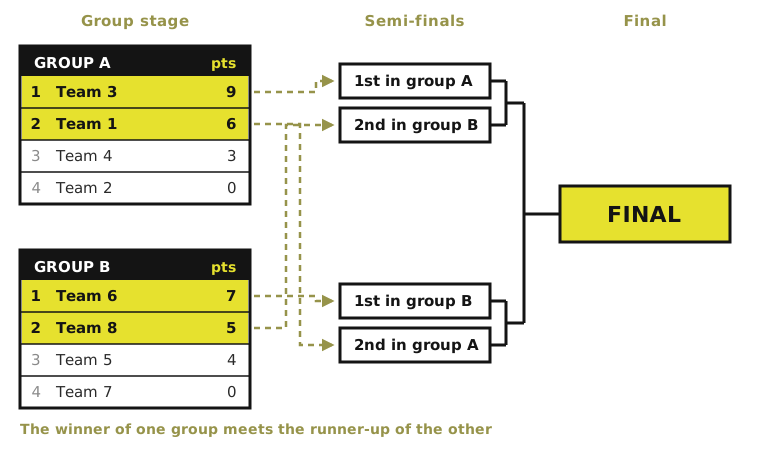
Unequal groups are where amateur tournaments get untidy. Split eleven teams 4 + 4 + 3 and the small group plays one match fewer per team, so raw points stop being comparable: use points per game, or take three qualifiers from the bigger groups. The knockout side of an awkward field is covered in a bracket for any number of players.
The schedule: pitches, timing, parallel matches
With the format fixed, the day is one line of arithmetic:
total time = matches × slot / pitches
Fifteen matches at a 20-minute slot on two pitches is 150 minutes — two and a half hours of football, before warm-up and the presentation. Try your own numbers:
How long will the tournament run
Group matches: 12 · Playoff: 3 · Total: 15 · about 2.5 hours
Two teams from each group go through; the playoff is a straight knockout.
Three rules for the day itself:
- Give every team a slot of rest — two matches back to back and the second is a walkover. With two groups and two pitches, run one group per pitch.
- Semi-finals in parallel, the final alone: equal recovery for both finalists, and everyone gets to watch the last match.
- Add 20–30 minutes of slack. Warm-up, a late team, an injury, the presentation — a schedule with no gaps collapses by lunchtime.
To see fixtures grouped into rounds rather than a flat list, use the matchweeks option.
Points, goal difference and what to do on a tie
Group tables run on the usual 3 for a win, 1 for a draw, 0 for a defeat. In the group a draw is a draw; in the knockout you need a decider, so agree in advance whether that is extra time, straight to penalties, or golden goal. The site can record the result of that: a shootout score is entered separately from the main score and counted differently in the table — update 5.10.1 explains how it works.
Level on points is not an edge case in football — with three group matches it happens constantly. The order of tie-breaks has to be written down before the first kick-off, and there are two common ones:
- Goal difference first: difference across the whole group, then goals scored, then the head-to-head result. The order most amateur tournaments copy from the World Cup.
- Head-to-head first: the result between the tied teams decides, and goal difference only after that. The order used in European club competitions.
Neither is more correct, but they produce different tables, and arguing about it after the last match is the worst possible moment. Whichever you pick, add a final tie-break that always resolves: a shoot-out, or a coin toss.
One trap: goal difference rewards thrashing the weakest team, so a group can be decided by a 9–0 that neither contender was involved in. If that bothers you, cap the difference counted per match in the rules.
Putting it together in Tlab.pro
A group stage plus a playoff is not one tournament in Tlab.pro but several linked ones — one per group, one for the bracket. Sounds like extra work; turns out to be less, because each group keeps its own clean table.
- Prepare the teams once. Add them in your profile, in the Tournament participants section, and tick Use existing participants in the wizard. The same team then carries its name, logo and line-up into every stage.
- One tournament per group. Format Round-robin, participants play each other once. The wizard is walked through in the help section.
- One tournament for the playoff. Format Playoff, eliminated after one defeat, third-place match on or off.
- Link them. On the playoff tournament open the Links tab, add the group tournaments, tick Group Stage for each and set the order and a short menu name — see the help topic on linking tournaments.
Linking buys two things: the stages become tabs in one tournament menu, and the playoff page grows a Group Stage block with a card per group — mini table, format, matches played out of the total, and a link to the full group. One address for the whole competition instead of four links in the chat.
What it does not do: the qualifiers are not moved into the bracket automatically. When the groups are finished you place the four teams into the playoff yourself — which is also when you apply the cross-over rule and check the tie-breaks by hand.
For the table, use automated statistics rather than typing numbers in. The basic set gives points, games, wins, draws, defeats, goals scored and conceded, and the points element is configurable — 3-1-0 is a default, not a law. Goal difference is a separate element of the type difference of 2 values: scored minus conceded. Then set the sort priority of the columns — points primary, goal difference secondary, goals scored third. That is your tie-break order, applied by the table itself.
Results go in on the Matches tab, with the match date and an Additional information field for the pitch number. Hand that job over: invite a referee as an editor, or let captains enter results themselves.
Frequently asked questions
How many matches is a football tournament for eight teams?
Seven for a straight knockout, 28 for a full round-robin, 15 for two groups of four plus semi-finals and a final — 16 with a third-place match. The last is the usual choice: three guaranteed games per team, and a proper final.
How long does a day with eight teams take?
Matches times the slot length, divided by the number of pitches. Fifteen matches, a 20-minute slot and two pitches is 150 minutes — call it three hours with the warm-up and the presentation. On one pitch the same tournament runs five.
What if we have an odd number of teams, like seven or eleven?
Groups do not have to be equal: eleven teams split 4 + 4 + 3 without trouble. The small group plays fewer matches, so compare points per game, or take a different number of qualifiers from it. An awkward knockout field is handled with byes — see a bracket for any number of players.
Who goes through if two teams finish level on points?
Whatever the rules say — and they have to say it before the tournament starts. The two usual orders are goal difference, goals scored, head-to-head; or head-to-head first and goal difference after. In Tlab.pro that is the sort priority of the columns, set once.
Do the group winners move into the playoff bracket automatically?
No. Linking shows the group tables next to the bracket and puts every stage in one menu, but you place the qualifiers yourself. In practice that is a feature: the cross-over pairing and any tie-break are decided by a human.
Once the groups are drawn, create the tournaments — one per group, one for the bracket — and link them. A quick overview of the group-stage tool is on the round robin schedule generator page.