Swiss system tournament: how it works and how many rounds
6/24/2026
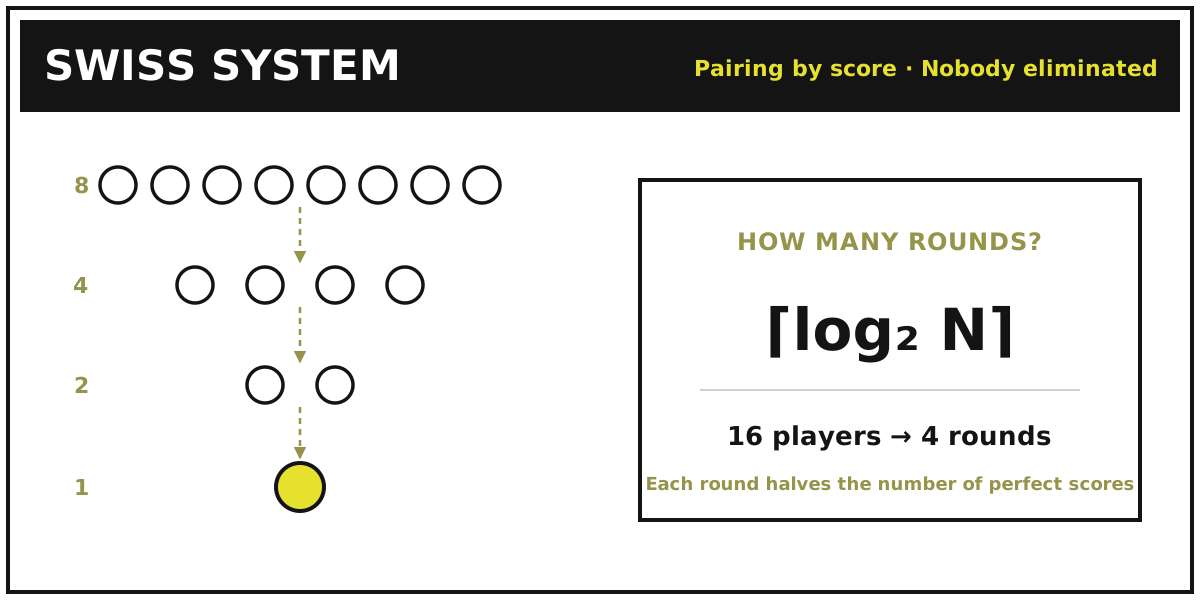
A round-robin is fair but slow; a knockout bracket is fast but merciless. The Swiss system sits exactly between the two: nobody is eliminated, everyone plays every round, yet a sole winner emerges after just ⌈log₂ N⌉ rounds — four rounds for 16 participants, seven for a hundred. Let's look at when the format makes sense, where the logarithm comes from, and how points, draws and byes are counted.
The rules in one minute
- Everyone plays a fixed number of rounds; nobody is eliminated.
- In the first round the pairs are drawn at random or by rating; from the second round on, participants with equal or similar scores play each other.
- The same pair never meets twice.
- With an odd number of participants, one of them sits out each round (a bye) and receives a walkover win; nobody gets more than one bye.
- After the last round the total score decides the standings; ties are resolved by tie-breakers such as the Buchholz coefficient.
When to use the Swiss system
The Swiss system shines when a round-robin would take too many matches and a knockout bracket would send half the field home after one game. Pick it when:
- There are many participants — from about a dozen up to hundreds — and a limited number of game slots.
- Everyone should play the whole event, not leave after the first loss.
- You need a full final ranking, not just a champion.
- The strength of the field is unknown: the system sorts the participants by itself, pairing equals against equals within a couple of rounds.
The price is a small one: the pairings of the next round can only be drawn after the previous one is finished, so the rounds run strictly one after another. If that does not fit your event, compare the alternatives in the format guide.
How many rounds: ⌈log₂ N⌉
Where does the logarithm come from? For a convincing winner you need a single participant with a perfect score. Every round the leaders play each other, so the group with 100% of the points shrinks roughly by half: 16 → 8 → 4 → 2 → 1. Halving N down to one takes log₂ N steps, and since a fraction of a round does not exist, we round up:
rounds = ⌈log₂ N⌉.
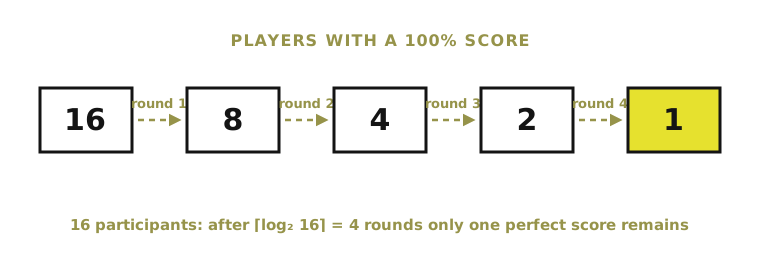
So 16 participants need 4 rounds, 30 participants need ⌈log₂ 30⌉ = 5, and even a field of 1000 is sorted out in 10. That is the minimum for a sole winner; if the places right below the top also matter — say, four qualifying spots — add one or two extra rounds so the middle of the table settles down too.
Try your own numbers:
Swiss rounds calculator
Rounds ⌈log₂ N⌉: 4 · Matches per round: 8 · Total matches: 32
For comparison, a round-robin with the same field would take 15 rounds.
The gap to a round-robin grows dramatically with the field:
| Participants (N) | Swiss rounds ⌈log₂ N⌉ | Matches per round | Round-robin rounds |
|---|---|---|---|
| 8 | 3 | 4 | 7 |
| 16 | 4 | 8 | 15 |
| 32 | 5 | 16 | 31 |
| 64 | 6 | 32 | 63 |
| 100 | 7 | 50 | 99 |
| 250 | 8 | 125 | 249 |
| 1000 | 10 | 500 | 999 |
Points, draws and byes
Scoring in the Swiss system is the usual points table. Chess tradition gives 1 for a win, ½ for a draw and 0 for a loss; team sports often prefer 3 – 1 – 0. Either works — what matters is that the running score is what the next pairings are built from.
Draws are not a problem for the format, they are fuel for it: half a point moves you into the middle score groups, where the system immediately finds you an opponent of matching strength. A bye is counted as a walkover win, so sitting out a round never costs anything.
Equal scores after the last round are separated by the Buchholz coefficient — the sum of the final scores of all opponents a participant has faced. The idea is simple: with the same number of points, the participant who played the tougher field ranks higher. That is fair precisely because the Swiss pairing gives leaders harder opposition every round.
How the pairings are drawn
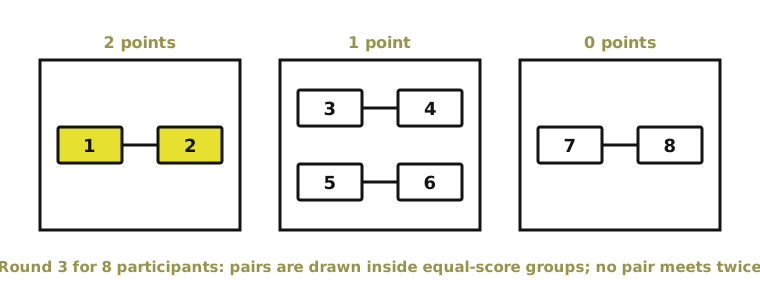
After a round finishes, the participants are grouped by their current score and pairs are drawn inside each group — the leaders play the leaders, the middle plays the middle. Two constraints are always respected: the same pair never meets twice, and if a score group is odd, someone plays a neighbour from the next group. This is why round 1 looks random but by round 3 the table already reads like a ranking.
Doing it in Tlab.pro
No spreadsheets required. In the tournament creation wizard pick the Swiss format at the tournament format step — the table columns are configured the same way as for a round-robin, and the wizard walkthrough is in the help section.
During the event, click New round — Tlab.pro groups the participants by score, suggests the pairings, avoids repeated pairs, shows who gets the bye, and lets you swap participants or regenerate the round. A new round opens only after all results of the current one are entered. The details are in the help topic about the Swiss system.
From there you just enter the results — or let the participants enter them — and the table recalculates itself, Buchholz included; automated statistics covers any extra indicator you want to track. If the Swiss stage qualifies players into a playoff, link the stages together — the brackets themselves have their own deep dives: single elimination and double elimination.
When you are ready, create your tournament — Tlab.pro takes care of the pairings, the byes and the maths. A quick overview of the tool itself is on the Swiss-system tournament generator page.